Why Mindful Pauses Fail (And What It Actually Takes to Break a Phone Habit)
We’ve all been there. It’s 3:00 PM on a Tuesday. You’re sitting at your desk, staring at a report, and you hit a mental wall. You don’t consciously decide to stop working. But suddenly, as if by magic, your phone is in your hand, Instagram is open, and you are twenty minutes deep into a doomscroll.
When you finally snap out of it, the guilt hits: Why do I have zero willpower?
A few years ago, brilliant developers realized that traditional screen-time limits didn't work, so they created "mindful friction" apps like One Sec. You click on an app, it forces you to take a deep breath for 5 seconds, and it wakes your brain up. Initially, it feels like a miracle. Your screen time drops.
But if you’ve used those apps for more than a couple of months, you’ve probably noticed a frustrating trend: Eventually, they stop working. To understand why passive pauses fail long-term—and how an app like Paced solves it—we have to look inside the biology of your brain.
How You Accidentally Wired a Digital Monster
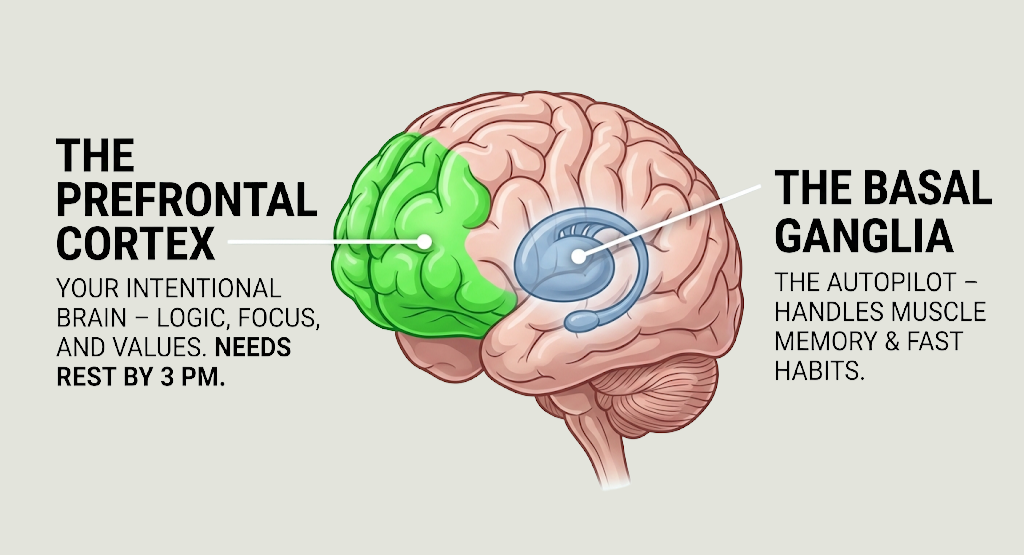
Your brain is a massive energy consumer. To survive and conserve fuel, it relies heavily on two main players:
The Prefrontal Cortex: This is your conscious executive center. It handles your logic, your deep work, and your willpower. But it is an absolute energy vampire. By 3:00 PM, after back-to-back meetings, it is completely exhausted. It desperately needs a break.
The Basal Ganglia: This is your primitive autopilot habit center. Its entire job is to take repetitive tasks and turn them into automatic routines so your conscious mind doesn't have to waste energy thinking about them. This is the part of your brain that handles muscle memory—like riding a bike, brushing your teeth, or driving home without remembering the turns.
For years, when your Prefrontal Cortex hit a wall at work, you made a conscious choice to open your phone for a quick hit of dopamine. But because you did that thousands of times, your Basal Ganglia said, "Excellent, let me automate this to save energy."
That is why, now, you find yourself grabbing your phone and opening your dopamine app on autopilot. The instant your brain gets tired, your autopilot takes the steering wheel. Your hand reaches out, unlocks the screen, and opens the feed entirely through muscle memory, without your conscious permission.
The Loophole in the Passive Pause
This is where apps like One Sec step in. When you click Instagram, the app interrupts the cycle and forces you to take a 5-second deep breath.
In the first week, this shock forces your sleeping Prefrontal Cortex to wake up. You realize you are on autopilot, you click away, and you feel in control.
But your Basal Ganglia is incredibly smart, and its drive to get that dopamine reward is powerful. Psychologists have a term for what happens next: Habit Stacking.
If you take that deep breath, but you still end up entering the app sixty or seventy percent of the time, your autopilot brain adapts to the rule. It doesn't break the addiction; it just updates its automated script. The new muscle memory sequence becomes:
[Hit a Wall at Work] ──► [Click Instagram] ──► [Take 5-Second Breath on Autopilot] ──► [Get Dopamine Reward]
Because you are still sitting in the exact same chair, staring at the exact same screen, and getting the exact same reward at the end, your brain learns to "fake" the mindfulness. The deep breath simply becomes the new "unlock code" you have to pay to get to your feed.
Why Paced Introduces an "Energy Tax"
When we built Paced, we knew we couldn't just add a passive, stationary step to your existing routine—or we would just become one more link in the habit chain. So instead of asking you to sit still and breathe, Paced introduces a physical circuit breaker. When you go to click an app, you are given a clear, pattern-interrupting choice: You can Walk, or you can Wait.
Let’s look at how these two options outsmart your autopilot brain in entirely different ways:
Option A: The Walk (The Energy Tax)
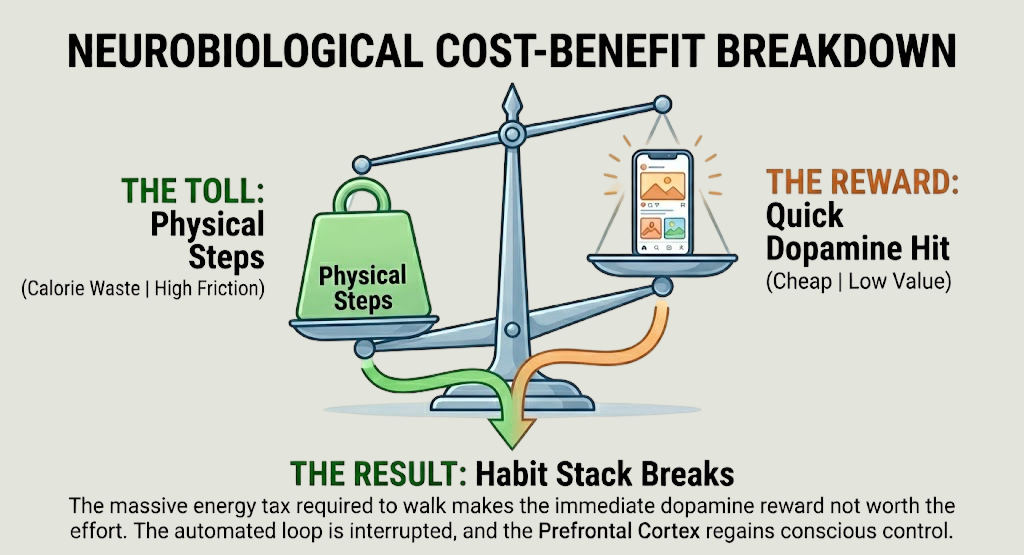
This option completely flips the neurobiological math because of one simple rule: The Basal Ganglia absolutely hates wasting physical energy. Its entire evolutionary purpose is calorie conservation.
When your autopilot tries to open an app and realizes that the "toll" to get in requires standing up, leaving your desk, and physically walking, your brain does a rapid, unconscious cost-benefit analysis. The reward of a cheap social media feed is suddenly outweighed by the physical effort required to get it.
The Basal Ganglia essentially says, "Absolutely not, that’s too expensive. Forget it." By requiring physical effort, Paced forces the autopilot to quit. The automated loop is completely broken, the craving naturally dissolves, and the steering wheel is handed right back to your conscious Prefrontal Cortex before you ever have the chance to fall into a trance.
Option B: The Wait (The Autonomy Trigger)
If you don't feel like walking, you can choose to wait. But this isn't a brief, 5-second pause where you hold your breath and wait for the screen to clear. Paced introduces a massive 60-minute circuit breaker.
This extended pocket of time completely forces your Prefrontal Cortex back online. You aren't just delaying the gratification for a few seconds; you are making a macro-decision about how to spend the next hour of your life. It gives you the space to choose a completely new path. Suddenly, you have the clarity to jump deep into a complex work project, step away to spend quality time with your family, or just protect your mental space by doing a little bit of nothing.
And here is the hidden psychological magic of this 60-minute block: Because you fill that hour with a completely different human experience every single time, your Basal Ganglia cannot form a pattern. There is no repetitive behavior to automate. By keeping your response dynamic over an entire hour, you completely shatter the old habit stack and keep yourself firmly in the driver’s seat.
Why You Might Eventually Delete Paced (And Why That’s the Point)
Let’s be completely honest: Paced is a high-friction app. It forces you to make a hard choice every single time your autopilot brain tries to wander. Because of that, there is a real chance you might hit a wall of friction fatigue and want to uninstall it.
If you reach that point, you are going to fall into one of two camps:
Camp 1: The Friction Is Just Too Much
You’re exhausted, you’re stressed, and you just want to look at your phone without having to walk or wait an hour. You are frustrated by the friction and you want to delete the app.
If you are in this camp, I get it. We all have days where our willpower is at zero. But before you hit uninstall and let your autopilot brain win, use the Emergency Unlock.
It will give you 15 minutes of uninterrupted time to do whatever you need to do on your phone. Yes, it resets your streak—because we are keeping things honest here—but it acts as a safety valve so you don't burn the whole system down. Use it when you truly need a break, and then let Paced back in to protect you tomorrow.
Camp 2: You’ve Successfully Broken the Reflex
You realize you haven't mindlessly reached for your phone in weeks. Your self-regulation muscle is strong, your Prefrontal Cortex is back in charge, and you feel like you don't need the training wheels anymore.
If you are in this camp, that is an incredible victory. But before you delete the app, my advice is to keep Paced installed anyway. Let it transition from your aggressive coach into your Silent Keeper. You might not need the blunt friction every day anymore, but leaving it running quietly in the background ensures that the next time you hit a high-stress month, your Basal Ganglia can't quietly sneak back in and rebuild the old addiction.
Move the Body, Clear the Mind
Breaking a digital addiction isn't about punishing yourself with rigid blockers, and it's not about relying on an exhausted mind to "willpower" its way through the day. It’s about understanding the biology of your habits.
Passive pauses are a great first step, but your brain will eventually outsmart them. If you want to permanently break the automated loops holding your focus hostage, you have to raise the cost of the distraction.
Want to break the loop?
If you’re ready to move past simple "mindful pauses" and want a tool that actually helps you rewire these automated habits, come check out what we’re building at Paced. You can learn more about our philosophy and download the app