Why Hard Locks Make Your Brain Rebel (And the Guilt of the Overridden Password)

It’s 10:00 PM. You are lying in bed, exhausted after a grueling day of decisions, meetings, and putting out fires. Your brain is entirely fried. You just want to check out and scroll for five minutes.
You pick up your phone, tap your social media folder, and—BAM. A giant, unyielding blocking screen takes over.
"Access Denied. You have reached your limit for today."
A few weeks ago, when you downloaded an app like Opal or turned on Apple’s built-in Screen Time controls, it felt like exactly what you needed. You wanted a strict digital fence. You asked it to lock you out. But standing in your bedroom right now, staring at that blank screen, something inside you shifts. You don’t feel protected. You feel restricted. You feel like a kid who just got sent to their room without dessert.
An intense wave of frustration hits you. Your hand and mind immediately kick into autopilot, searching for a workaround. Within forty seconds, you are digging deep into your phone settings, typing in a master override code, or tapping "Ignore Limit for 15 Minutes."
The lock screen vanishes, the feed loads, and you get your dopamine. But as you sit there scrolling, the reward tastes hollow. It's immediately replaced by a heavy, familiar sense of guilt and shame: I am an adult running a life, a career, or a household. Why do I need to treat myself like a toddler just to stay off my phone? And why can’t I even stick to the rules I set for myself?
If you have ever felt this specific shame, I need you to take a deep breath. You are not weak, you are not lazy, and you don’t lack willpower.
You are experiencing a completely predictable, natural human reflex called Psychological Reactance. And to understand why your hard blocker keeps forcing you into a cycle of rebellion and guilt, we have to look at what happens when technology tries to steal your autonomy.
What Does Autonomy Actually Mean?
In psychology, autonomy isn't just a fancy word for freedom. It is a fundamental human need. True autonomy means feeling like you are the author and the boss of your own choices. When you act with autonomy, you are making a decision because you weigh the options, accept the trade-offs, and say, "I am choosing this path because it's what I want to do." When a hard blocker steps in, it completely hijacks that process. It changes your reality from “I am choosing to focus right now” to “A piece of software is forcing me to sit still.” By stripping away your ability to guide yourself, it insults your intelligence. It tells your brain: You aren't capable of making this choice on your own, so I'm taking the keys away.
That is the exact moment the rebellion starts.
If you have kids, or if you remember being one, you already know exactly how this works. Think about what happens when you look at a child and say, "Do not touch that box on the counter. It is strictly off-limits." Five minutes ago, that child didn't even know the box existed. They had zero desire to touch it.
But the exact millisecond you put a rigid boundary around it and took away their choice, a switch flipped. Suddenly, that box is the only thing they can think about. Their curiosity explodes, their defiance kicks in, and they want to touch it more than anything else on the planet.
As adults, we like to think we’ve outgrown this phase. We haven't. When an app puts a strict lock on your phone, it accidentally triggers that exact same childhood reflex. The second a behavior is strictly forbidden, your brain throws a temper tantrum. The app you wanted to avoid suddenly becomes exponentially more attractive simply because it is off-limits. It’s the classic "forbidden fruit" effect.
Your brain’s sole mission shifts from “I need to stay focused and finish this project” to “Let me get my freedom back from this lockout screen.” Instead of naturally returning to your actual work, your mind gets completely hijacked by an annoying internal argument, aggressively hunting for loopholes just to get into the app: "Well, I just need to check that one urgent DM anyway," or "What if someone left an important comment?" Eventually, the mental exhaustion of fighting your own phone peaks. To prove that you are still the one in the driver’s seat, your brain triggers what researchers call a Boomerang Effect—a powerful psychological pushback where you intentionally break the rule and open the distraction just to reclaim your independence.
You dig into your settings, type in the override password, or delete the app entirely.
The shame you feel afterward isn't because you are undisciplined. It's because you forced yourself into a war where you had to choose between focus and freedom. And your brain will choose freedom every single time.
Shifting from "Digital Jails" to "Fluid Friction"
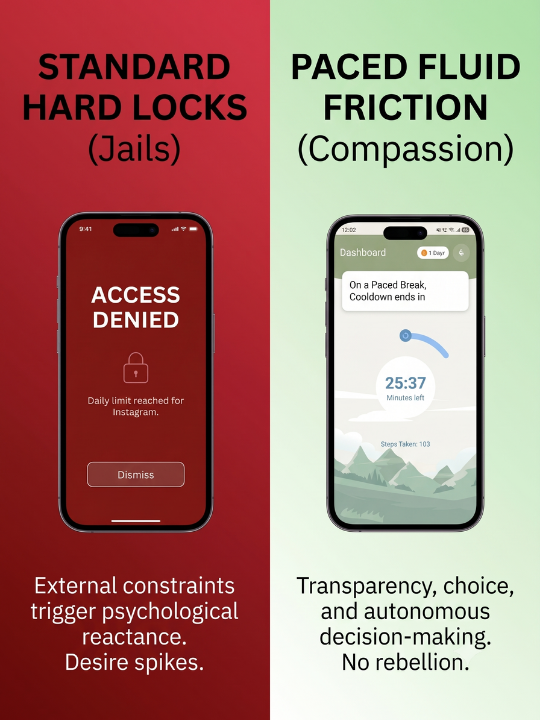
When we built Paced, we realized that breaking a digital trance shouldn't require you to give up your status as an autonomous adult. We didn't want to build another digital fence that relies on punishing limits, because forcing someone to comply doesn't build a real habit.
Now, if tools like Opal or default system blockers work for your specific workflow, that is a massive win, and you should absolutely keep using them. There is no judgment here; different minds need different parameters, and we are all just trying to survive an attention economy engineered to hijack us.
But if you find yourself constantly breaking those rules and feeling the exhaustion of the lockout screen, Paced introduces a completely different approach called Fluid Friction.
Instead of treating you like a child, Paced treats you like a partner. When your usage limit runs out and you go to open a time-suck app, Paced doesn't throw up a permanent wall. It looks at you and says: "We aren't going to permanently lock you out. There is a cooldown timer running before you can scroll again—but you have complete autonomy over how you handle this wait."
You are given a transparent choice: The Walk or The Wait.
[Limit Expired] ──► Paced Cooldown Screen (Timer Starts)
                         │
                         ├──► Option A: The Wait (Let the clock run down)
                         ├──► Option B: The Walk (Take steps to reduce the timer faster)
                         └──► Emergency Unlock: (Physical verification phrase / 15-min access)
If you choose The Wait, you simply let the cooldown timer run its course before the app opens back up.
But if you want to speed up that clock, you can choose The Walk. This is a physical circuit breaker to clear your mind. By linking directly with your phone's built-in step counter, every 100 steps you take reduces your wait timer by 3 minutes. You aren't "earning" or buying screen time like a child doing chores; you are actively using physical movement to melt the wait time away.
This isn't an execution or a punishment. It is a moment of compassion for your nervous system.
When you leave your desk and move your body, you are giving your brain exactly what it was actually begging for when you reached for your phone: a break. Walking shifts you out of that intense, staring-at-a-screen stress loop and physically resets your energy.
By the time you finish those steps and reduce the timer to zero, one of two beautiful things happens:
The craving naturally dissolves. You realize you don't even want the app anymore because the movement gave your mind the actual refreshment it needed. You put the phone away, feeling entirely in control.
You still want to check the app—and that is completely okay. The timer is done. You moved your body, you woke up your conscious mind, and you can now open that app completely shame-free, knowing you chose a healthy transaction over an autopilot relapse.
The Emergency Unlock: Real Life Requires Flexibility
Now, you might look at that choice and ask: “What if I’m a passenger in a car on a long road trip? What if I'm having a high-stress day and I honestly just want to look at my phone right now without walking or waiting?”
Traditional blockers assume your life is perfectly predictable. When they block you during an unexpected moment, they force you to break your own rules just to function—which instantly triggers that wave of guilt.
Paced handles this reality differently by offering an Emergency Unlock. It gives you 15 minutes of uninterrupted access right away when you genuinely need it.
But here is the critical difference between using our Emergency Unlock and hitting "Ignore Limit" on a default phone lock: You have to own the decision. To activate the 15 minutes, Paced requires you to physically type out a phrase: "I am making a mindful choice."
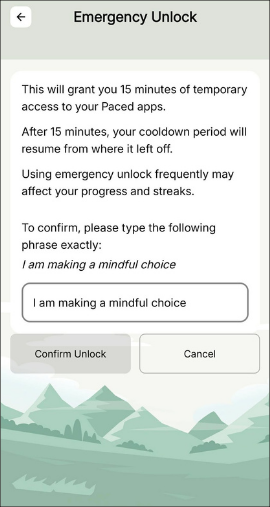
You aren't cheating the system, and you aren't finding a lazy loophole. You are taking a beat, shifting out of your autopilot habit loops, and executing an adult, conscious override.
There is zero shame in doing it. To keep the app's internal data completely honest, using the Emergency Unlock will reset your active streak badge. This isn’t a penalty or a slap on the wrist—it’s just keeping the data accurate. It acknowledges that today was a high-friction day, resets the tracker to a clean slate, and prepares to protect your focus again tomorrow. By building that intentional flexibility right into the design, Paced ensures that a chaotic afternoon won't cause you to delete the whole system out of frustration.
Compassion Over Constraints
Fixing our relationship with our phones isn’t about forcing ourselves into a state of rigid compliance, and it’s certainly not about living in a constant loop of guilt. Default controls and traditional blocking apps are well-intentioned, but if you are tired of typing in emergency passwords, hitting "Ignore Limit" for the tenth time today, and feeling like you've failed an invisible willpower test, it’s time to try a system built on compassion rather than constraints.
You don't need a stricter boss running your screen time. You just need to keep your autonomy intact.
Ready to change the pattern?
Paced is 100% ad-free and currently live for Android users on the Google Play Store, with our highly anticipated iOS version launching this Summer 2026. [Download Paced today or join our iOS waitlist here](https://www.getpaced.app) to start reducing your wait time with real movement—shame-free.