Why Choice Beats Force: The Real Reason "Wait vs. Walk" Breaks the Screen Trance
We have all been there. You are sitting at your desk, hitting a wall on a difficult project, and before your conscious mind even registers what is happening, your phone is in your hand.
Your thumb is already hovering over the icon. You didn't make a plan to open it; your brain was just hunting for a quick escape from a moment of mental fatigue.
If you are using a traditional app blocker, this is the exact moment you hit an unyielding wall. A screen pops up telling you that you are locked out. And your brain instantly rebels against that restriction.
But when we built Paced, we asked a different question: What if we didn't force you to stay out? What if, instead of treating you like a child, we gave you a choice that forced your brain to wake up?
That is the entire philosophy behind Paced’s Cooldown Screen and the choice between The Wait or The Walk.
Willpower Is a Bad Strategy
Most digital wellness tools are built on a broken idea: that you just need more discipline. They think that if they show you a motivational quote or make you take a deep breath, you will suddenly find the strength to put your phone down.
But behavioral science shows us a different reality. When you are exhausted, the part of your brain responsible for logic and self-regulation is completely offline. You cannot logic your way out of a deep dopamine loop when your battery is running on empty.
Paced doesn't rely on your willpower. It uses Fluid Friction.
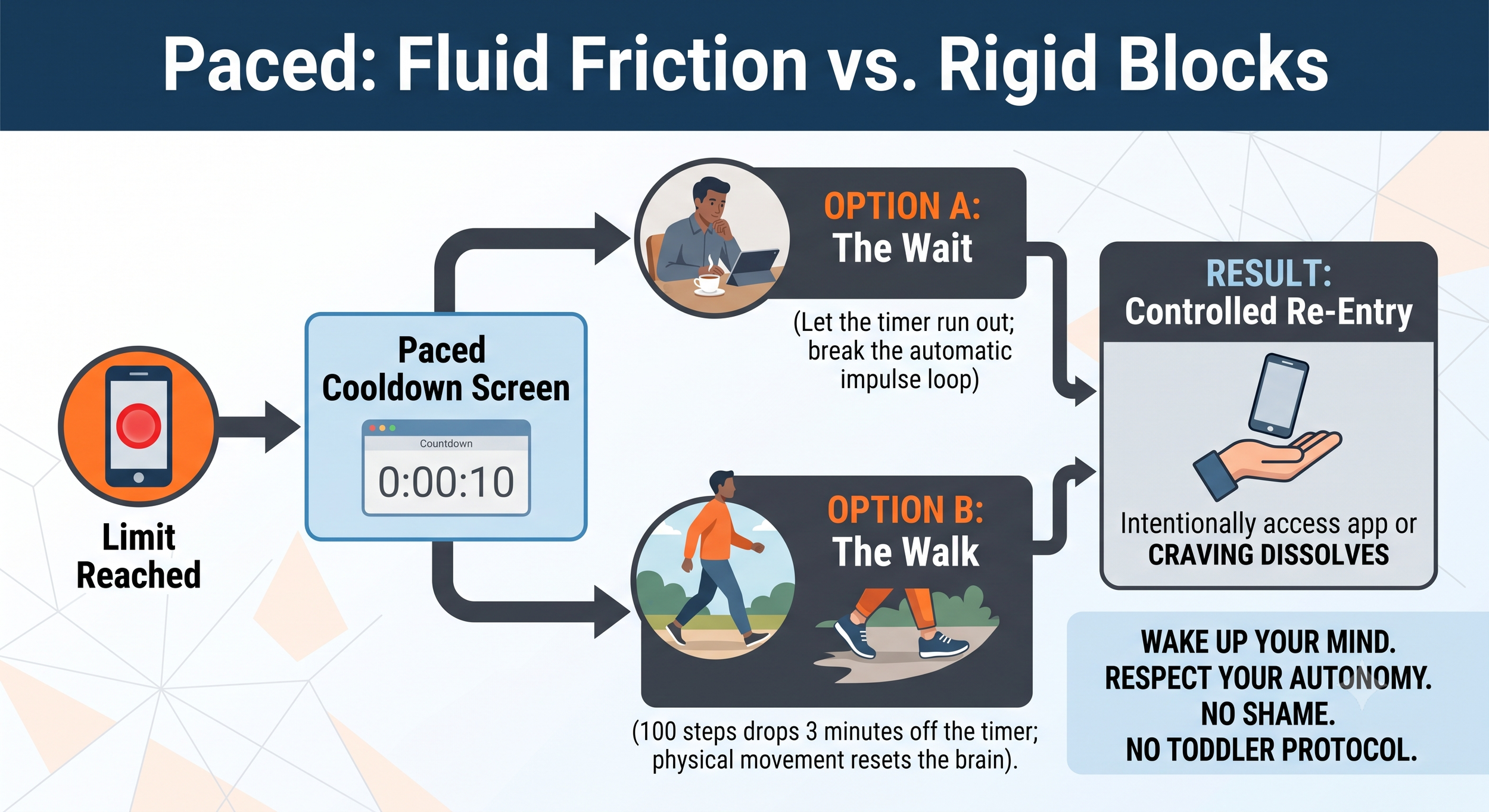
When your usage limit runs out, Paced doesn't lock the door forever. Instead, it slows you down and presents you with two specific paths.
                                                ┌─── [THE WAIT] ───➔ Let the clock run down.
[LIMIT EXPIRED] ───────┤
                                                └─── [THE WALK] ───➔ 100 steps = -3 mins off the timer.
Path A: The Wait
If you choose to Wait, you simply let the cooldown timer run its course before the app opens back up. We aren't telling you "No." We are telling you "Not yet."
This delay acts as a speed bump for your subconscious. It forces a gap between the automatic impulse to scroll and the actual consumption. Just by making you wait, the urge loses its edge. You are forced to sit with that craving for a while, which is usually just enough time for your mind to snap out of its trance and ask, “Do I actually want to look at this, or am I just avoiding this task?”
Path B: The Walk
If you don't want to wait, you have the ability to speed up the clock using The Walk. By linking directly with your phone's built-in step counter, every 100 steps you take reduces your wait timer by 3 minutes.
This isn't a penalty. It is a moment of compassion for your nervous system.
When you leave your desk and move your body, you are giving your brain exactly what it was begging for when you reached for your phone: a break. Walking shifts you out of that intense, staring-at-a-screen stress loop and physically resets your energy.
By the time you finish those steps and reduce the timer to zero, one of two things happens:
The craving naturally dissolves. The movement gave your mind the actual refreshment it needed. You put the phone away, feeling entirely back in the driver's seat.
You still want to check the app. And that is completely fine. The timer is done, your mind is awake, and you can open that app completely shame-free, knowing you chose an intentional action over an autopilot relapse.
Restoring Your Status as an Adult
Forcing compliance doesn't build a real habit. If a piece of software forces you to stay off your phone, the software gets the credit, and you are left feeling like a toddler.
But when you are given a real choice—when you weigh the trade-off between waiting it out or moving your body—you keep your control intact. You are the author of the decision.
Fixing our relationship with technology isn't about running away from our devices or living in a constant state of restriction. It’s about building systems that respect our intelligence and give us our control back.