Why Your Willpower is Broken (And How I Built a Way to Walk it Off)
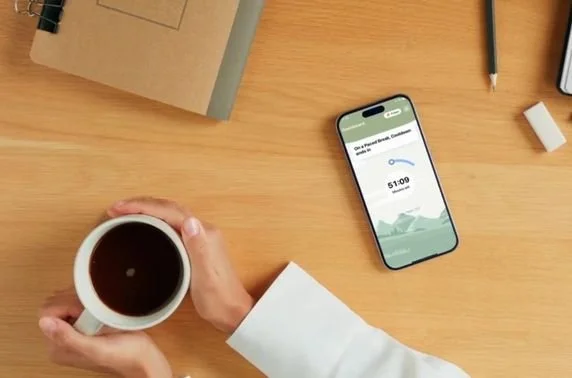
"I spent three months on Instagram last night."
When the French journalist Alain McKenna opened his article about Paced with that line, I laughed out loud. But then, a second later, I felt that familiar, heavy sink in my chest. Because I’ve been there. We all have.
For twelve years, I’ve worked as a Realtor in Saskatoon. In my industry, like in so many of yours, your phone is your office. You pick it up to answer a quick client text, check an email, or update a listing.
And then, the "scroll trance" takes over.
Suddenly, forty-five minutes of your evening have vanished. You’re staring at Instagram Reels or TikTok, completely numb. You look up, the room is dark, and instead of feeling rested from your break, you feel completely drained, scattered, and guilty.
You think: What is wrong with me? Why can’t I just have some willpower?
If you've felt that wave of self-blame, I want you to take a deep, shame-free breath. You are not lazy. And you don’t lack willpower.
You are just a human brain trying to fight a supercomputer. These apps are engineered around what I call the "Seduction Algorithm." They are literally designed by rooms of neuroscientists to keep you trapped in an endless loop. Staring at your screen isn’t a personal failure—it’s biology.
But while the apps are designed to steal your attention, you can take it back. And the secret to doing that isn't white-knuckling your way through a lockout. It’s a concept James Clear talks about in Atomic Habits: adding friction.
The Habit Formula: Making the bad stuff harder
In Atomic Habits, James Clear shares a simple rule for breaking a bad habit: Make it difficult.
You have to insert friction between your autopilot brain and the action. If you have to physically get up and go to another room to check your phone, you do it less. Simple, right?
But in our digital lives, we try to create "friction" by using traditional screen-time apps or Apple's built-in limits. They act like digital jailers. They throw up a hard wall and lock you out.
The problem is, when an app treats us like children, our brains naturally rebel. There is a psychological reflex called reactance. When our freedom is completely stripped away, we feel an overwhelming urge to regain control. So we click "Ignore Limit," type in the override passcode at 10:00 PM, and scroll anyway—only now we feel twice as much guilt.
I knew there had to be a more compassionate way to build a habit. We didn't need digital fences; we needed a gentle touch on the shoulder to snap us out of the trance.
Wait it out, or walk it off
That's why I built Paced. For my 50th birthday, I decided to launch an "unfancy tech startup" to solve my own screen addiction and prove it's never too late to take back control.
I wanted to design an app that felt like a supportive partner, not a prison guard. I wanted to give users their agency back.
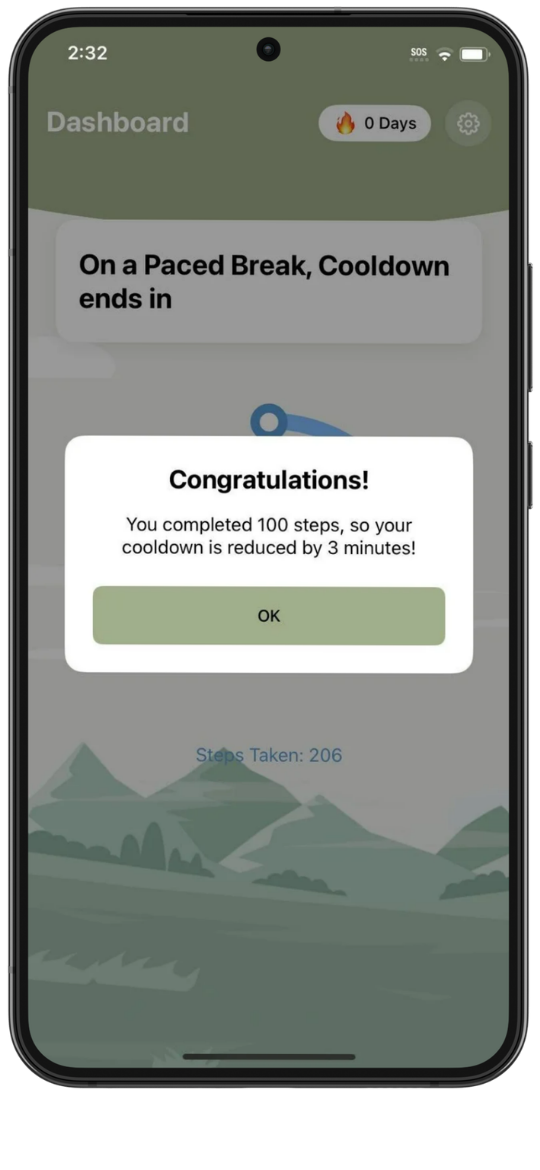
With Paced, when you hit your limit, a "cooldown" period triggers. Typically, it locks your chosen social or news apps for an hour. But instead of a hard, frustrating lockout, Paced gives you a choice: Wait out the timer, or walk it off.
Walk or Wait
If you want to bypass the lockout, you can trade physical steps for screen time. The "Golden Ratio" we built is 100 steps for 3 minutes of time returned.
To completely unlock your apps early, you need to walk about 2,000 steps—which is a decent, 15-minute stroll.
This isn't just a fitness gimmick. It’s behavioral science.
When you get hit with an app lockout, your brain experiences a sudden crash in cheap dopamine, which triggers frustration. But when you physically step away, put your phone in your pocket, and start moving—whether you walk around the block or just pace your living room—you change your physical state.
Your blood starts pumping. Your environment changes. The movement acts as a kinetic circuit breaker that physically breaks the autopilot dopamine loop.
And here’s the neat part: by the time you've walked enough steps to unlock your phone, you often realize you don't even want to scroll anymore. You’ve successfully transitioned from mindless numbing-out back to active living.
Reclaiming your time
When I originally sat down with Google Gemini to start mapping out this app, I had no tech background. I just had a real-world problem and a desire to build something that put people back in the driver’s seat of their own lives.
And the early results have been surreal. With Paced supporting 134 active users over the last 30 days, we are seeing a 33.6% stickiness (DAU/MAU) ratio—which is nearly double what most consumer apps see. Even more exciting, 57% of our weekly active users open Paced every single day to stay on track.
Why? Because choice beats force every single time. When you are the one choosing to walk, you aren't just following an app's rule—you're building a new, healthy daily habit.
You don't need to lock your phone in a physical box or feel guilty about using social media. You just need a supportive coach that redirects your energy.
Ready to Find Your Pace?
Stop fighting the Seduction Algorithm alone with sheer willpower. Let elegant, compassionate guardrails protect your focus and put you back in the driver's seat of your time.
Download Paced for Free on iOS & Android 100% Ad-Free. No credit card required.